Calendar
of
Events
Delaware
***********
Northern
Central
Southern
Beaches
Maryland
***********
Upper-Shore
Mid-Shore
Lower-Shore
Ocean
City
Virginia
***********
Eastern
Shore
***********
State
and
County Fairs
Visit our
Gift
Shop
--------------
Support:
We are a for profit
site and while we
perfer
your support via visits and purchases from our advertisers you may
support this site through a donation.
|
The Delmarva Peninsula sits in the Mid-Atlanic region of the United
States between the Chesapeake Bay to its west and the Delaware
Bay
and Atlantic Ocean to its East. The peninisula has areas that
are
in three states with its name
being
formed from letters of the states of Delaware,
Maryland and
Virginia.
The name Delmarva Peninsula is a recent name with the first known use
of Delmarva being in the early 20th Century. It began as
commerical names of businesses that served consumers in the
three
states and then expanding to the entire Peninsula.
One possible northern boundary for the peninsula could be the
Chesapeake and Delaware Canal. This would
technically make it an Island, since you can't get on or off of the
peninsula without crossing a body of water. However it's still regarded
as a peninsula since the canal is man-made.
A canal across the peninsula between the Delaware River and the
Chesapeake Bay was first proposed by Augustine Herman in the
mid-1600s. It wasn’t until the late 18th century
that surveys of possible water routes were made.
In 1802 the Chesapeake and Delaware Canal Company was
incorporated. Construction began in 1814, but due to
lack of funds the project was halted in 1816. In 1822 the
canal company reorganized and with monetary support from Pennsylvania,
Maryland, Delaware and the Federal Government work began again in April
1824. It was open for business in 1829 at a cost of near 2.5
million dollars.
The canal of 1829 is much different than it is today. In 1829
it
was 14 miles long, 10 feet deep, 66 feet wide at the water line and 36
feet at the bottom. Locks existed at Delaware City and St.
Georges Delaware as well as two at Chesapeake City Maryland.
In 1919, the Federal Government purchased the canal. In the
six years from 1921 to 1927 the Army Corps of Engineers converted it to
a sea-level canal, widened it, and removed all the locks. Today the
canal is 450 feet wide with a depth of 35 feet. The canal is
a modern sea-level commercial waterway that carries about 40 percent of
the ship traffic to the Port of Baltimore.
From the C&D canal to the peninsula’s southern point
at the tip of the Eastern Shore of Virginia it is about 180 miles. At
its widest it's about 60 miles, although most of the peninsula is much
narrower. The land area is about 5.45 thousand square miles.
The western or Chesapeake Bay coast is indented and marshy.
Most of its western coast is Maryland’s Eastern Shore. The
rest is the Virginia Eastern Shore west coast. The eastern
coast is more regular with sandy beaches, especially along the Atlantic
Ocean.
There are 5 bridges over the C&D canal to get onto the
peninsula. These are at MD 213, Delaware 896, US 13, Delaware 1 and US
9. There is also a railroad bridge that crosses the canal east of
Delaware 896. There are two accesses to the peninsula across the
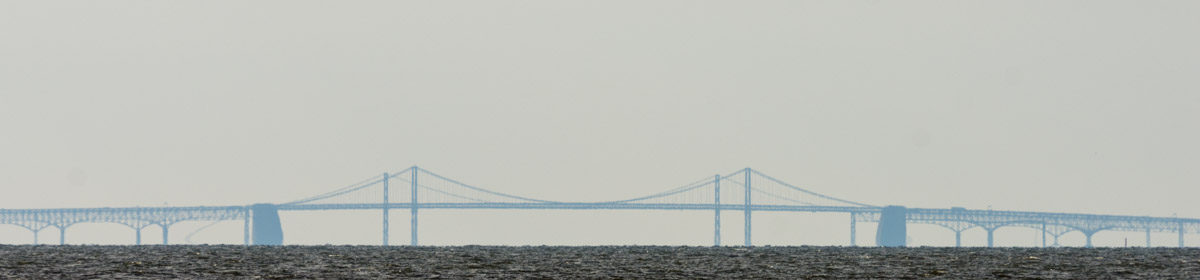
Chesapeake Bay. One is the Chesapeake Bay Bridge, which crosses the bay
near Annapolis Maryland to Kent Island. The other is the
Chesapeake Bay Bridge-Tunnel, which, links Cape Charles, Va., the
southern tip of the peninsula, with Norfolk, VA.
Prior to the opening of Maryland’s Chesapeake Bay Bridge,
officially called the William Preston Lane, Jr., Memorial Bridge in
1952, the only route across the Chesapeake Bay was through
ferries. A parallel structure with three lanes was opened in
1973. These lanes are used for west bound traffic while the
original 2 lane span is used for those east bound.
The shore–to-shore length of 4.3 miles makes it a long scenic
over-water structure. Beginning in 1975, typically on an
early
Sunday in May, the east bound span has been closed to traffic for use
by
walkers for a scenic view of the bridge and bay. The last Bay Bridge
Walk was held in 2006. The 2007 walk was canceled due to
weather
conditions and for 2008 and 2009 due to the Bay
Bridge
Preservation Project. Once again the Bridge Walk has been
canceled for 2010.
Across the mouth of the Chesapeake Bay where it meets the Atlantic
Ocean there is The Chesapeake Bay Bridge-Tunnel, officially the Lucius
J. Kellam, Jr. Bridge-Tunnel. Its shore-to-shore distance is
17.6 miles and connects the Virgina town of Cape Charles with the city
of Norfolk.
The Bridge-Tunnel opened in 1964, and consists of more than 12 miles of
low trestle bridges, two suspension bridges and two tunnels, each a
mile long under the shipping channels. It is considered the
largest bridge-tunnel complex in the world.
Nine of Maryland's 23 counties are located on the peninsula. These
being the counties of Kent, Queen Anne's, Talbot, Caroline, Dorchester,
Wicomico, Somerset, Worcester and a portion of Cecil County. The
Virginia counties of Accomack and Northampton and the Delaware Counties
of Kent, Sussex and a portion of New Castle County makes up the rest.
A major part of the Delmarva Peninsula’s economy is through
agriculture, aquaculture, sports hunting and fishing, and tourism.
At various times in its history residents of the Maryland and Virginia
portion of the peninsula have propose that they should secede from
their respective states. Some believe they should join
Delaware to create a new state called
Delmarva.
|
Our

For a Limited Time we are accepting Monthly Advertising for
this Page
|
Sponsors

Advertiser

|